
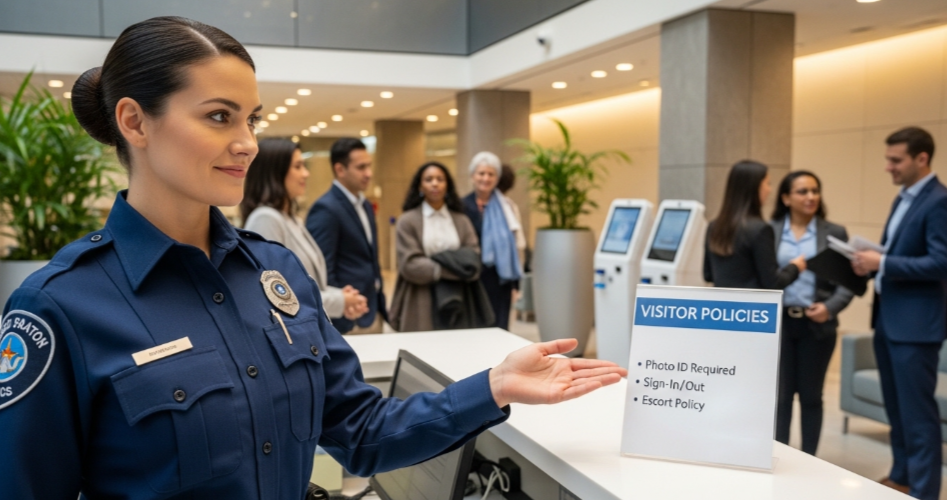

Front Desk Security Guards: Visitor Policies That Actually Get Followed
If your visitor policy only works on paper, it is not a real policy. People arrive early, show up unannounced, forget who they are meeting, and push for shortcuts when the lobby is busy. This guide stays practical, with steps you can run using front desk security guards and a clear visitor management routine. For coverage built around your entry points and daily traffic, start with FlagGuard and our Front Desk Security service.
Why Visitor Policies Fail When the Lobby Gets Busy After Hours
Most breakdowns happen during the same windows: lunch rush, shift change, and after-hours vendor access. In those moments, “just let them in” becomes normal, and that is when a building loses control. Strong front desk safety & security means real front desk safety and security that stays consistent.
The most common failure points we see in front desk security procedures:
- No single owner for approvals, so exceptions pile up
- Manual visitor log entries that are incomplete or skipped
- Badges that look like stickers, so nobody takes them seriously
- Weak host notification rules, so visitors wait and wander
- No clear escort policy for vendors and contractors
For office and mixed-use properties, this is part of broader Commercial Security coverage because the lobby sets the tone for the entire site.
The Five-Step Visitor Flow That People Actually Follow Daily
Policies get followed when the flow is short, clear, and enforced the same way every time. Think of it as a five-step path. A front desk security officer can run it quickly without turning the lobby into a bottleneck.
Step 1: Pre-arrival confirmation
- Expected guest list for meetings, interviews, tours, and vendors
- Clear “who can approve” rule for walk-ins
Step 2: Arrival and identity verification
- Basic identity verification with a consistent check
- Purpose of visit and host name captured
Step 3: Check-in and badge
- Time-stamped check-in in the visitor log
- A visible visitor badge was issued and explained
Step 4: Controlled access
- Visitor stays in approved zones only
- The escort policy is applied when required
Step 5: Check-out and closure
- Badge returned
- Time-stamped check-out noted
This routine is easier to roll out when your plan is written down in the same step-by-step format we use in Our Process.
Identity Verification That Feels Calm and Still Reduces Risk
A strong lobby does not feel tense. It feels organized. The goal is to confirm who someone is and where they are going, without turning it into an interrogation. This is where concierge security services and a trained concierge security officer add value, because the approach stays professional while access stays controlled.
Practical ways to run identity verification without slowing the lobby:
- Use the same two questions for everyone: “Who are you meeting?” and “What company are you with?”
- Confirm the host name, not just “they are expecting me.”
- If the visit is not on the list, move to approval, not entry
If you are not sure which controls match your building type, a quick Security Risk Assessment helps define what matters most, such as public access hours, tenant mix, and high-traffic entry points.
Visitor Badges That Make It Obvious Who Belongs in the Building
Badges are not decorations. When a badge is clear, staff and tenants can spot “unbadged” people quickly, and guards can intervene early.
A simple visitor badge standard that gets followed:
- Large text that says, VISITOR
- Date and time issued
- Expiration time, even if it is a rough window
- Host name or department
- “escort policy” printed when applicable
Badges work best when paired with video surveillance on the lobby entry line and elevator access. If you want stronger visibility and cleaner documentation, Surveillance & Monitoring support can add an extra layer that helps the front desk stay consistent, especially during after-hours access.
Escort Policy Rules for Vendors, Contractors, and Deliveries
Most visitor policies break down because vendors and deliveries are treated as “not visitors.” In practice, they are the group most likely to request shortcuts, especially when they have done the job before.
A simple escort policy that stays realistic:
- Interviews and first-time visitors: escort to the meeting point
- Vendors and contractors: escort for restricted areas and back-of-house zones
- Deliveries: controlled handoff area, not roaming access
- Any visitor without a host response: wait in the lobby, no exceptions
This is where it helps to align your policy with the property type, which is why we map procedures by environment in Industries We Serve.
Host Notification and Accountability That Stops Visitors From Wandering
The host is part of security. If the host does not respond, visitors linger, get frustrated, and start moving. That is how problems start, even when everyone had good intentions.
A host notification plan that works:
- Host is notified immediately at check-in
- The host has a set time window to arrive or respond
- If the host does not respond, the visitor is rescheduled or escorted out
- Repeat “no-show hosts” are flagged to management
For properties in high-traffic areas, including Los Angeles coverage, this one change alone reduces lobby friction because everyone understands the rule in advance.
Front Desk Security Procedures for Exceptions and Pushback

If your policy cannot handle exceptions, it will fail. People push back in predictable ways. “I come here every week.” “I forgot my ID.” “I am just dropping something off.” Your front desk security guard’s duties should include a clear script for these moments, and your front desk security guard should know exactly how to apply it.
Use a simple three-lane decision:
- Approved and verified: badge and proceed
- Not verified, but can be approved: hold, call host, wait
- Not verified and not approved: deny entry, offer reschedule
Common exception categories to define:
- Recurring vendors with scheduled windows
- Tenant guests after hours
- Delivery drivers with no host contact
Parking is a common leverage point for shortcuts. If your site has repeat parking conflicts tied to visitor access, pairing policy with Parking Enforcement support can help keep visitor spaces clear and reduce arguments at the front desk.
Visitor Logs and Audit Trails That Protect Management Later
The visitor log is not just recordkeeping. It is protection. When something goes wrong, the building needs a timeline, not guesses. A clean log also helps you spot patterns early, such as the same vendor arriving outside approved hours.
Minimum fields that make logs useful:
- Full name and company
- Host name
- Time in and time out
- Badge number or identifier
- Reason for visit
- Escort required, yes or no
- Notes on exceptions or refusals
For ongoing clarity, a regularly updated security blog can reinforce your rules without sounding harsh.
What Front Desk Security Jobs Should Look Like on a Well-Run Site
Not every lobby role is the same. Some buildings want a welcoming presence with strong policy support. Others need strict access control and constant documentation. The best front desk security jobs are clear about expectations, training, and authority.
A well-defined front desk security job duties list usually includes:
- Run the visitor flow consistently
- Perform identity verification and maintain the visitor log
- Issue and track visitor badge use
- Apply the escort policy to the visitor log
- Issue and track visitor badge use
- Apply the escort policy to the visitor log
- Issue and track visitor badge use
- Apply the escort policy rules for restricted areas
- Handle escalations calmly and document incidents
- Coordinate with property management and tenant leadership
Many buildings also benefit from a security concierge officer approach, where the guard supports a professional tone while keeping access controlled. If you want to understand how we structure training, screening, and supervision, start with About our team.
A Simple Staffing Plan for Front Desk Security Guards That Works

Coverage fails when staffing does not match traffic. A single guard can run a calm lobby. A single guard can also get overwhelmed during peak windows. Your plan should be built around actual arrival patterns, not a guess.
A practical staffing approach:
- Peak hours: one dedicated lobby post, no competing tasks
- After-hours: one lobby post plus periodic perimeter checks if allowed
- Events or tours: temporary support for check-in surges
If you are ready to tighten your visitor policy and reduce friction at the entry point, talk with us through Contact Us. We will ask about your building type, peak traffic windows, and the exceptions that cause the most trouble.
Get Concierge Security Guard Services That Keep Your Policies Followed
The goal is simple: a lobby that feels professional, calm, and controlled. When visitor policies are easy to follow, staff stop improvising, tenants feel supported, and unauthorized access drops.
If you want front desk security that is built around your hours, entry layout, and tenant needs, request a quote through Get a Quote. We will recommend a coverage plan with consistent reporting and a visitor flow that people follow.