


Construction Security in Riverside Protecting Equipment Overnight

A superintendent in Corona locks the gate at 5 PM on a Friday. By Monday morning, the site has a missing generator, a stripped run of copper wire, and a fuel tank that’s a hundred gallons lighter. Nobody saw it happen because nobody was there to see it. That gap, the sixty-plus hours between the last truck leaving on Friday and the first one arriving Monday, is where most construction losses in Riverside County actually happen.
Riverside’s building boom hasn’t slowed down. Warehouse shells keep rising along the 215 and 60 freeway corridors, tract homes keep filling in around Corona and Temecula, and commercial pads keep breaking ground near Moreno Valley and Perris. Every one of those active sites holds equipment, materials, and tools that are worth real money to someone willing to cut a fence at 2 AM. This piece focuses on the overnight window specifically: what makes it dangerous, and what a working protection plan for a Riverside job site actually looks like once the crews go home for the day.
For general contractors juggling multiple active builds across the county, overnight coverage often gets treated as an afterthought. It shouldn’t be. A single missing skid steer or a stripped run of copper can wipe out weeks of margin on a project, and that’s before factoring in the schedule delay while replacement equipment gets sourced. The good news is that overnight risk is manageable once you understand exactly where the gaps are and what a licensed construction site security guard actually does to close them.
Why the Overnight Hours Are the Real Risk Window
Daytime theft on an active job site is rare. There are too many people around, too many trucks coming and going, and too much activity for anyone to slip in unnoticed. Overnight is a different story. Once the last crew clears out, a site with no dedicated coverage sits quiet, poorly lit, and unwatched for eight, ten, sometimes sixty hours straight over a long weekend.
A construction security company that only offers daytime coverage is solving half a problem. The real exposure starts around dusk and runs until the first trades show up the next morning. Weeknight windows between roughly 1 AM and 5 AM tend to target fuel, tools, and copper, quick grabs that don’t require much time on-site. Weekends and holidays are worse, because the clock resets and nobody’s checking the property for two or three straight days. A licensed site security guard walking the property during those exact hours is the single biggest variable that changes the outcome.
There’s also a seasonal pattern worth knowing about. Riverside’s stretch of hot, dry months from late spring through early fall tends to correlate with longer daylight hours but shorter crew days, since many contractors shift start times earlier to beat the heat. That means sites sit unattended earlier in the evening than owners expect, which is exactly when a construction security guard on a staggered patrol schedule earns their keep.
What Actually Disappears From Riverside Job Sites at Night
Ask any general contractor who’s had a bad year, and the list is fairly consistent. Copper wire and pipe top it, since scrap value makes it close to instant cash. Battery-powered tools, cordless drills, saws, and packs from brands crews rely on daily are light, easy to carry, and simple to resell online. Diesel and gasoline get siphoned straight from equipment tanks. Catalytic converters get cut off parked machines in under two minutes with a battery saw.
Heavy equipment security deserves its own mention, because it’s a different category of loss entirely. Theft of a skid steer, mini excavator, or trailer happens less often than the smaller stuff, but it causes the most serious damage. A stolen machine doesn’t just cost the replacement price. It stalls the whole project while a rental gets sourced and insurance paperwork works its way through. Building materials staged for a residential install- lumber, rebar, plumbing fixtures, and appliances- round out the list.
Industry groups that track heavy equipment losses, including the National Equipment Register, have long pointed out that recovery rates on stolen machinery stay low across the country. Once a piece of equipment leaves a fenced perimeter, the odds of getting it back drop fast. That’s the core argument for prevention over recovery. A construction site security guard on-site overnight is there to stop the loss before it happens, not to help write the police report afterward.
The Freeway Corridors Fueling Riverside’s Construction, and Its Theft Problem
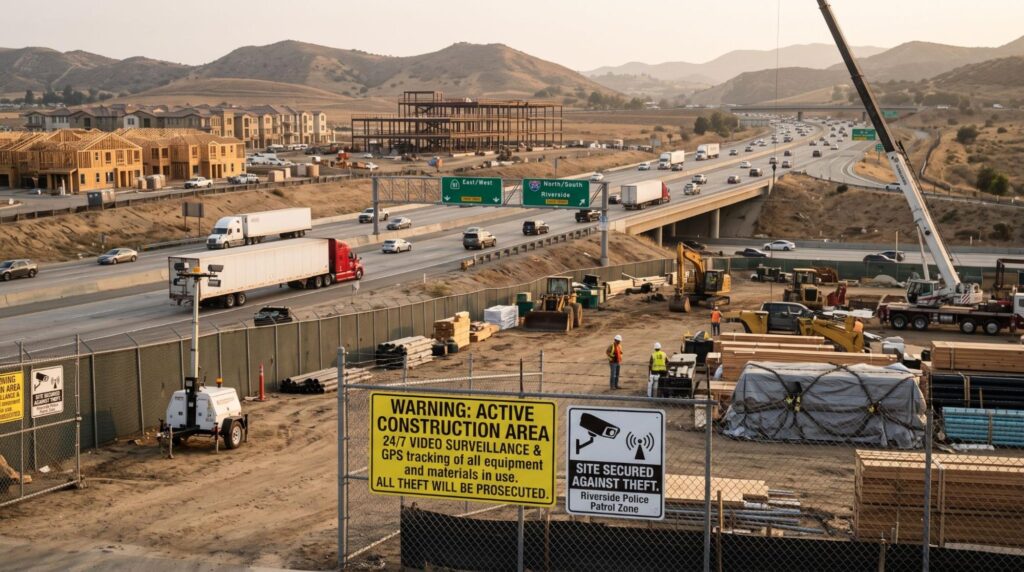
Riverside County’s growth is tied directly to its freeways. Warehouse and logistics development stretches heavily along the 215 and 60, feeding distribution demand from the Inland Empire’s position between Los Angeles and the rest of the Southwest. The 91 corridor through Corona keeps adding retail and residential product. Temecula and Murrieta continue expanding south, and Moreno Valley and Perris carry a steady stream of new industrial pads near March Air Reserve Base.
That same freeway access that makes Riverside attractive for developers also makes it convenient for anyone looking to move stolen equipment or materials out of the county fast. A site sitting a half-mile off the 215 with an unlit yard and a chain-link fence isn’t a hard target. It’s an easy one. This is part of why FlagGuard’s security guard services across Riverside County put so much weight on site-specific planning rather than a generic patrol route. A warehouse shell near Perris and a residential tract in Temecula don’t share the same risk profile, even though they’re twenty minutes apart on the same freeway.
Jurupa Valley and Eastvale add another layer to the picture. Both cities sit close to the 15 and 60 interchange, an area that’s seen heavy industrial and logistics development over the past several years. Sites in that stretch tend to be large, multi-acre properties with long perimeters, which makes mobile patrol coverage a more practical fit than a single fixed guard post trying to watch every corner from one spot.
Building an Overnight Protection Plan That Actually Works
A good overnight plan isn’t one thing. It’s several small disciplines running together, night after night, without gaps.
Lighting and sight lines matter more than people think.
A dark yard hides everything, including the guard trying to patrol it. Keeping equipment rows, gates, and laydown areas lit, and keeping pallets or trailers from blocking those sight lines, removes the shadows a thief depends on.
Gate control has to be consistent, not occasional.
Every vehicle in or out overnight should get checked against a roster. A truck that doesn’t match a scheduled delivery, or shows up at an odd hour, gets stopped before it’s inside the fence, not questioned after it’s already loaded up.
Patrol timing needs to vary.
A guard who walks the same loop at the same time every night is predictable, and predictable is exploitable. Staggered rounds through the equipment yard, the perimeter fence line, and material storage zones make it much harder for anyone to time a coverage gap.
Reporting should happen in real time, not the next morning.
A superintendent shouldn’t find out about a cut fence section on Monday. Mobile patrol construction site security in Riverside that includes live activity logs and PatrolLIVE-style tracking means anything unusual overnight lands in an inbox before the first crew clocks in, not after the loss is already counted.
None of this requires exotic technology. It requires a licensed construction security company that treats overnight coverage as its own discipline instead of an afterthought tacked onto daytime service. As a side note, guards making regular rounds also tend to catch smaller compliance issues along the way: a missing lockbox, an unsecured ladder, or a supply of hard hats on construction sites left out in the open overnight. It’s not the main job, but it helps supers stay ahead of safety walkthroughs, not just theft reports.
The Real Cost of Skipping Overnight Coverage
Most owners run the math on security wrong. They look at the monthly cost of a guard and stop there, without weighing it against what a single incident actually costs. A stolen skid steer means replacement cost plus weeks of delay while a rental gets sourced and delivered. A copper theft event means material cost plus the labor hours to re-pull an entire run of wire that was already finished. A stripped catalytic converter means downtime on a piece of equipment that was supposed to be working that morning, not sitting in a shop.
There’s a compounding cost too, one that’s harder to put a number on. Repeat losses on a project make a general contractor look unprepared to the property owner or developer, and that reputation follows into the next bid. Insurance carriers notice patterns as well, and a site with multiple claims in a short window can see renewal terms tighten. None of that shows up on a monthly invoice, but it shows up eventually.
Compared against that full picture, a construction site security guard covering the overnight window on an active Riverside project tends to pencil out, especially on jobs running longer than a few months with copper, fuel, or heavy equipment sitting on-site.
Cameras and Fencing Alone Don’t Stop Anything
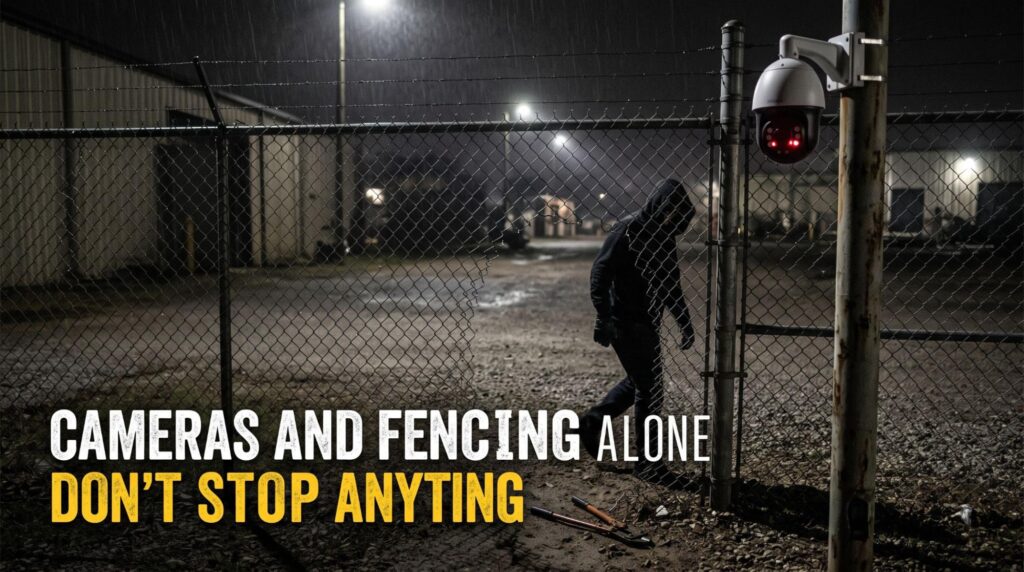
A six-foot temporary fence slows almost nobody down. Bolt cutters clear a padlock in under a minute. Cameras are useful for documentation, but by definition they only show what already happened. They don’t stop the loss in progress.
This is why most experienced Riverside general contractors combine fencing and cameras with an actual person on-site or on rotation through the property. A trained officer is the only part of that system capable of deciding in the moment: approaching a vehicle that shouldn’t be there, checking a gate that’s ajar, or calling the right people the second something looks wrong. FlagGuard covered this trade-off in more depth in Mobile Patrol vs. On-Site Guards: Which Is Right for Your Property, which walks through how to decide between the two coverage types depending on site size and schedule.
And for a deeper look at the specific blind spots that let theft happen even on sites that think they’re covered, the 7 Blind Spots construction security piece is worth a read before your next site walk.
What to Look for in a Riverside Construction Security Company
Not every security vendor is actually set up to run a construction post well. Job sites change layout constantly, sit exposed to weather, and don’t run on a nine-to-five schedule. Before signing with any construction site security guard company in Riverside County, it’s worth confirming a few basics:
An active California BSIS PPO license, which any legitimate vendor should be able to provide on request. General liability insurance with certificates of insurance available for your general contractor or project owner. Post orders written for your specific site, your gates, your risk windows, your layout, rather than a copy-paste template used everywhere. Real-time or daily activity reporting delivered to the people actually managing the project. And genuine local response capacity in Riverside County, not a company dispatching a guard from two counties away when you need someone on-site within the hour.
That last point matters more than it seems. A construction security company with actual boots on the ground in Riverside County can walk a site same-day when something changes, whether that’s a new phase starting, a fence line moving, or a theft incident that needs an immediate response. A vendor managing your site remotely from another region rarely offers that.
A trained site security guard who’s walked your property before quoting, asked about your fence lines and storage zones, and shown up on shift one with a written plan is a very different experience than a guard pulled at random from a rotation with no context on the job. This is also where it pays to ask how construction site security guards are actually trained and screened before assignment, not just whether they’re licensed on paper.
Get an Overnight Security Plan Built Around Your Riverside Site
Whether it’s a warehouse shell near Perris, a tract build outside Corona, or a multi-phase commercial project along the 91, the right coverage plan comes from understanding how your specific site operates after the crews leave, not from a one-size-fits-all patrol schedule. FlagGuard is a licensed construction security company providing construction site security services and 24/7 mobile patrol across Riverside County, with PatrolLIVE reporting and officers trained specifically for active job sites.
Call 818-818-8111 or request a free quote. Share your site address, project timeline, and current risk points, and you’ll get a coverage plan and pricing back within one business day.
Frequently Asked Questions
What time of night are construction sites most likely to get hit?
Most overnight construction theft in Riverside County happens between roughly 1 AM and 5 AM on weeknights, and across the full closure window on weekends and holidays. Long stretches with no crew on-site give thieves more time to work without pressure, which is why coverage during exactly those hours matters more than daytime patrol alone.
Do I need a security guard if my site already has cameras?
Cameras document what happened, but they don’t stop it in progress. A construction site security guard can intervene before a loss occurs, checking a gate, approaching an unfamiliar vehicle, or calling for help immediately, while a camera system simply provides a recording after the fact. Most Riverside contractors run both together rather than relying on one or the other.
How much does construction site security cost in Riverside County?
Pricing depends on coverage hours, whether you need on-site posting or mobile patrol, site size, and project length. Most Riverside County job sites fall into a standard per-hour range for licensed guards, and FlagGuard provides an itemized quote after a short site review with no long-term contract required.
What’s the difference between mobile patrol and on-site guards for a construction project?
On-site guards stay at one location for the full shift, which suits sites with high-value equipment or active theft history. Mobile patrol rotates a marked vehicle across several properties on a staggered schedule, which works well for smaller sites or multi-location contractors who need overnight checks without full-time staffing at each one.
How do I get construction site security set up for my Riverside project?
Call FlagGuard at 818-818-8111 or fill out the quote form on the contact page. Share your site address, project phase, and current coverage gaps, and you’ll get a tailored plan covering guard hours, patrol routes, and reporting before your next risk window hits.