
Hospital Security in Los Angeles A Facility Manager’s Guide
If you manage security for a hospital or clinic in Los Angeles, you already know the job isn’t like guarding an office building. A hospital never closes. People arrive in crisis, at 3 a.m., through doors that have to stay open no matter what. Add in LA’s traffic patterns, its sprawl, and the sheer density of medical facilities packed along corridors like Wilshire and Sunset, and you’ve got a security challenge that looks nothing like a standard commercial property.
This guide breaks down what actually goes into a hospital security plan in Los Angeles — the access points that matter most, what regulators expect, how staffing models differ, and what coverage typically costs. It’s written for facility managers and administrators who need a working plan, not a sales pitch.
Why Hospital Security in Los Angeles Looks Different From Other Cities
LA County is home to some of the busiest medical systems in the country, from the LAC+USC Medical Center campus near Boyle Heights to UCLA’s facilities around Westwood and the dense cluster of hospitals and medical office buildings along the Wilshire corridor. That concentration creates a specific kind of pressure: high patient volume, constant vehicle and foot traffic, and campuses that often span multiple buildings connected by parking structures, walkways, and loading docks.
Freeway access adds another layer. Facilities near the 101, 110, 10, and 405 pull patients and visitors from wide catchment areas, which means unpredictable surges — a multi-car collision on the 101 can send a wave of arrivals to a nearby ER within minutes. FlagGuard provides licensed security guard services across Los Angeles built around this kind of geography, and hospitals sit near the top of the list for facilities that need coverage designed around real traffic patterns rather than a flat, one-size-fits-all staffing model.
The Real Access Points Facility Managers Have to Cover
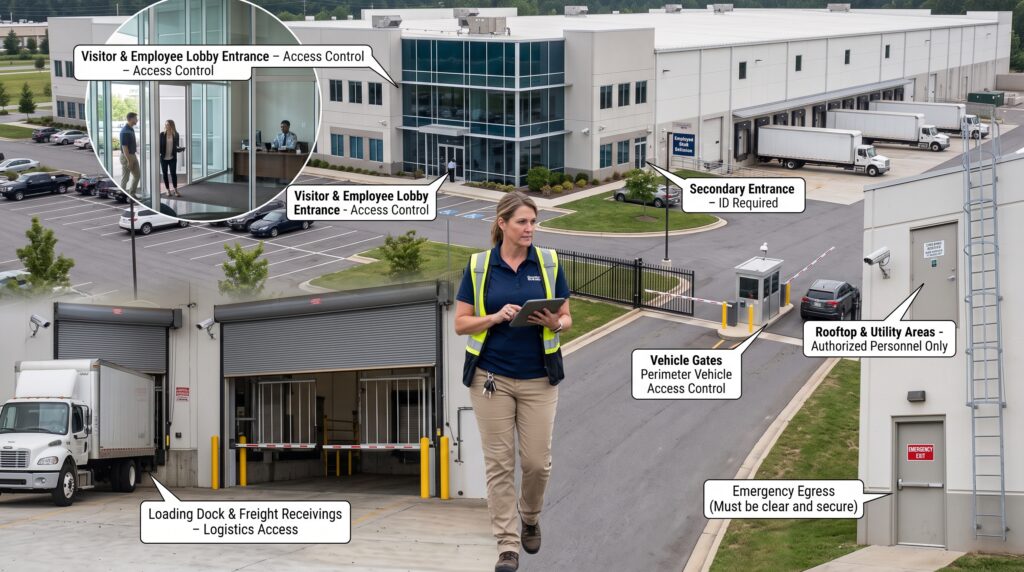
Every hospital has more entrances than people assume. There’s the main lobby, but also the ER ambulance bay, staff entrances, loading docks, pharmacy access, and often a separate entrance for behavioral health or psychiatric units. Each one carries different risks.
A few areas deserve specific attention:
- The ER entrance, where volume is highest, and tempers can run short during long waits
- Parking structures and surface lots, especially after dark
- Pharmacy and medication storage zones, which need controlled, logged access
- Behavioral health units, where de-escalation training matters more than physical presence
Facility managers who treat all entrances the same tend to end up understaffed where it counts and overstaffed where it doesn’t. A proper medical facility security plan starts by mapping these zones individually and assigning coverage based on actual traffic and risk, not a guard-per-square-foot formula.
What OSHA and BSIS Expect From Hospital Security Programs
Two frameworks shape hospital security in California, and it’s worth understanding both before you build a staffing plan.
OSHA has published guidance specifically for healthcare and social service workers on preventing workplace violence, recognizing that hospitals face a meaningfully higher rate of on-the-job violence than most other industries. It doesn’t mandate a specific staffing ratio, but it does expect facilities to have a documented violence prevention program, which typically includes trained security personnel as one layer of that plan.
On the guard side, California requires every security officer to be licensed and trained under the Bureau of Security and Investigative Services. That’s the baseline: background checks, drug testing, and certified training for any guard working at a licensed facility, hospital, or otherwise. It’s not optional, and any vendor who treats it as a formality is one you should walk away from. Weak documentation around access control and visitor policy is also one of several security failures that tend to create liability for facilities generally, and hospitals carry extra exposure given how many people move through them daily.
HIPAA-Aware Guards: What That Actually Means Day to Day
“HIPAA-aware” gets thrown around a lot in security marketing, so it’s worth being specific about what it should mean in practice. A guard working a hospital floor sees patient names on whiteboards, overhears conversations at the nurses’ station, and sometimes has to respond to incidents involving a specific patient’s condition. None of that is theoretical.
Real HIPAA-aware training covers what a guard can and can’t discuss, how to document an incident without including unnecessary patient health details, and how to handle situations involving family members who show up demanding information they’re not entitled to. If your current security vendor can’t explain their HIPAA training beyond “yes, we do that,” it’s a fair question to push on.
Front Desk and Lobby Coverage: Where Most Visitor Problems Start
A hospital lobby isn’t just a waiting room. It’s the first checkpoint for visitors, deliveries, discharged patients, and the occasional person who shouldn’t be there at all. Getting that first checkpoint right prevents a lot of downstream problems.
A clear, consistently enforced front desk visitor policy, sign-in procedures, badge checks, and defined visiting hours for sensitive units do more to prevent incidents than any amount of reactive patrol. Guards stationed at intake need the authority and training to enforce that policy calmly, without turning every interaction into a confrontation, which matters more in a hospital than almost anywhere else.
Staffing Models: In-House, Contracted, or Hybrid
Most LA facilities land on one of three staffing approaches, and each has real tradeoffs.
In-house security gives you direct control and guards who know the building inside out, but it also means you own recruiting, training, scheduling, and liability directly. Contracted security shifts that operational load to a licensed vendor, which usually means faster coverage for gaps, backup staffing during call-outs, and access to technology like real-time patrol tracking without building it yourself. A hybrid model, a small in-house team supplemented by a contracted vendor for overnight or peak-volume shifts, is common at mid-sized hospitals that want continuity without carrying full-time headcount for every hour of the day.
There’s no universally right answer here. A 24-hour trauma center near a freeway corridor has different needs than a single-location outpatient clinic in the Valley, and the staffing model should follow the facility’s actual traffic patterns, not a generic template.
What Hospital Security Actually Costs in Los Angeles
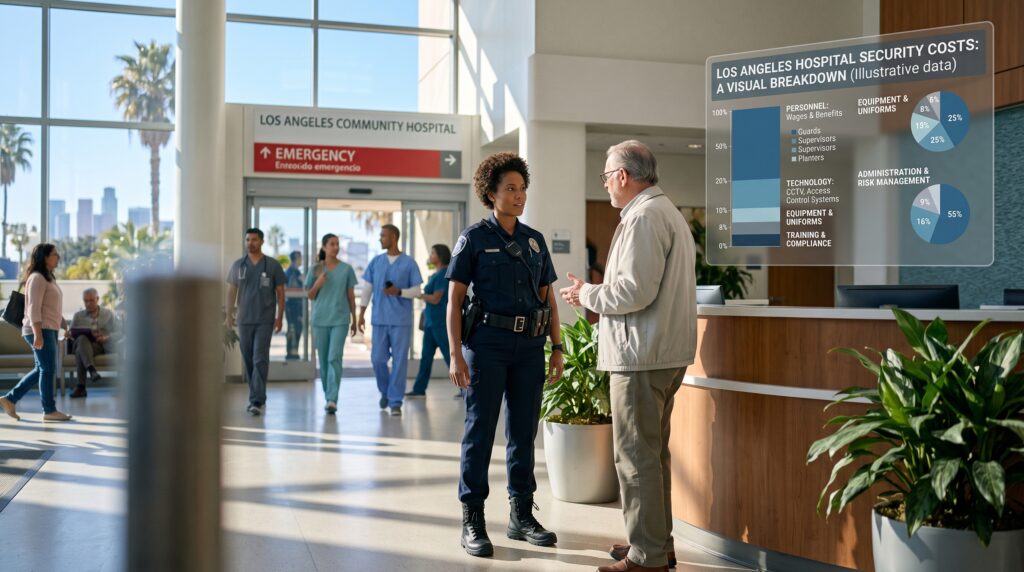
Pricing depends on more variables than most facility managers expect going in: number of guards per shift, armed versus unarmed coverage, whether you need dedicated behavioral health or pharmacy zone coverage, and total hours of coverage across a week. A single unarmed guard covering an overnight shift costs meaningfully less than a multi-guard, multi-zone daytime deployment at a busy ER.
Rather than quote a flat number that won’t hold up across different facility types, the more useful exercise is mapping your specific zones and shift patterns first, then getting a quote built around that, not a generic per-hour rate that ignores your actual layout.
Building the Right Plan for Your Facility
Not every security company that lists “healthcare” on their services page has real hospital experience. Ask specific questions: How do your guards handle a behavioral health incident? What’s your process if a family member becomes aggressive at intake? How do you document incidents without violating patient privacy? The right partner should answer those without hesitation, because they’ve built post orders around real hospital environments, not adapted a commercial office template.
Getting there takes more than a quote request. It takes someone who’ll walk your facility, map your access points, and build coverage around how your hospital actually operates. Reach out to FlagGuard to start that conversation and get a plan built around your facility instead of a generic package.
FAQs
How much does hospital security cost in California?
Hospital security pricing depends on the number of guards per shift, armed versus unarmed coverage, and how many zones need dedicated coverage: ER, pharmacy, behavioral health, and general patrol. Facilities with 24/7 coverage and multiple high-traffic entrances will naturally cost more than a single-location outpatient clinic. The most accurate way to get pricing is a walkthrough of your specific facility rather than a flat quote.
Do hospitals need armed security guards?
Not every hospital requires armed coverage, but many facilities, particularly larger trauma centers and those in high-traffic urban areas, opt for it as part of their overall risk plan. The decision usually comes down to facility size, patient volume, and prior incident history rather than a blanket rule. A security assessment can help determine whether armed or unarmed coverage fits your specific risk profile.
What does a hospital security guard actually do?
Hospital security guards manage entrance and lobby access, patrol ER and waiting areas, monitor parking structures, and respond to behavioral incidents with de-escalation training rather than force as a first option. They also support staff during high-stress situations and coordinate with hospital administration on incident documentation. The role blends visible deterrence with calm, HIPAA-aware conduct around patients and families.
Is hospital security guard coverage armed or unarmed?
Both options exist, and most facilities use a mix depending on the zone. Behavioral health units and general patient floors often use unarmed, de-escalation-trained guards, while entrances or high-risk areas may warrant armed coverage. The right combination depends on your facility’s layout, patient population, and documented risk factors.
How do I get a hospital security plan for my facility in Los Angeles?
Start with a site walkthrough that maps your entrances, high-traffic zones, and shift patterns, since a generic staffing template rarely fits a hospital’s actual operations. FlagGuard builds hospital and medical facility security plans across Los Angeles County based on this kind of assessment. Call 818-818-8111 or request a quote through the contact page to get started.