
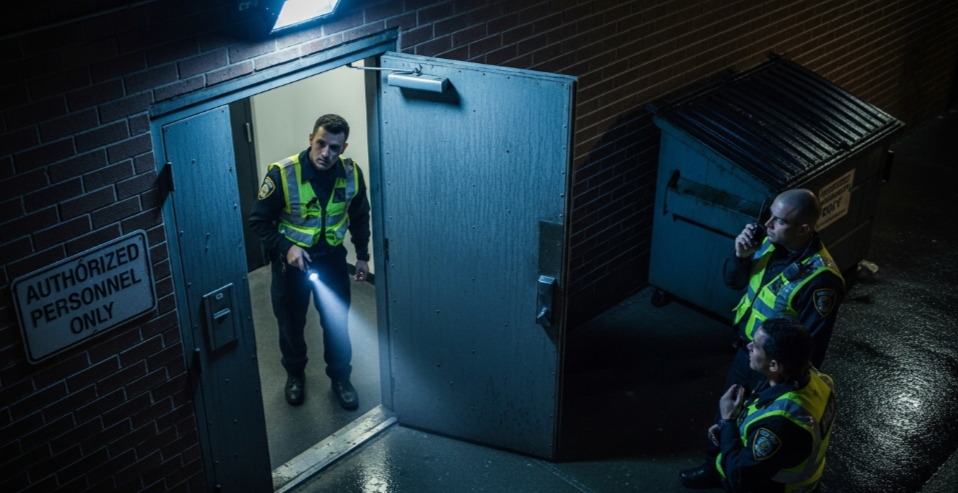

Office Building Security Guards: Preventing After-Hours Break-Ins at Side Doors
When an office building gets hit after hours, it is rarely the front lobby that fails first. It is the side door by the loading area, the stairwell exit that does not latch, or the employee entrance that gets propped “for just a minute.”
In Southern California, those small habits turn into predictable patterns. In this guide, we keep it human and break down what we see on real properties and how an office building security guard and a trained team of office building security guards help stop repeat break-ins at side doors with better access control, smarter checks, and clean documentation.
If you want help building a site-first plan, our team at FlagGuard is set up to provide security for office buildings across Los Angeles County.
Why Side Doors Trigger After-Hours Break-Ins in Office Buildings
Side doors are convenient. They are also quieter, less visible, and easier to test without being noticed. A lot of “break-ins” start as no-force entry: a door that was not locked, a latch that did not catch, or a credential that was shared. A statewide trend update notes California’s property crime rate fell to 2,084 incidents per 100,000 residents in 2024, with burglaries down 11.8% year over year. However, burglary is still a daily operational risk for businesses. See 2,084 incidents per 100,000 residents, and burglary is down 11.8% for the exact figures.
For a busy building, the side-door risk usually grows when:
- Tenants work late and use the closest exit, not the safest one
- Cleaners and vendors enter through a back door with little oversight
- Delivery doors are left cracked during last-minute pickups
- Stairwell doors are treated like “nobody checks these.”
That is where office building security stops being a checklist and becomes a routine.
Seven Side-Door Weak Points That Hurt Commercial Building Security
If you manage commercial building security, these are the failures that show up again and again:
- Door closers that slam, then bounce open
- Strike plates that do not line up, so the latch never fully locks
- Badge readers on the main entrance, but a side door with no reader
- Propped doors during smoke breaks and late-night deliveries
- Stairwell exit doors that people use as shortcuts
- Cameras aimed at the hallway, not the actual door handle and latch area
- No written process for lock-up, so every shift does it differently
A good building security company does not just point these out. We document them, fix what we can immediately, and build the checks into post orders so the same gap does not repeat next week.
How Office Building Security Guards Prevent No-Force Side-Door Entry
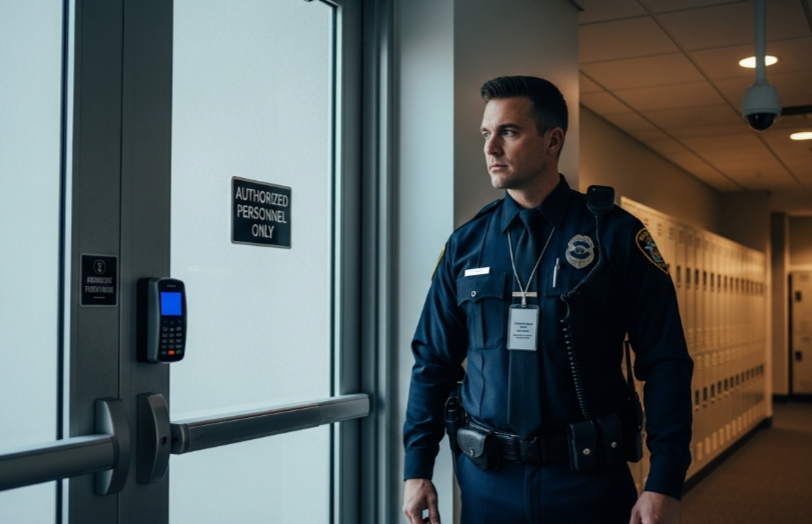
Most side-door incidents are preventable because they are not sophisticated. They are opportunistic. A modern workplace security overview notes 60% have experienced a breach in their physical security in the last five years, and 75% of companies list physical security as a top concern. The point is not to scare anyone. It is to show that “we thought our doors were fine” is a common story.
Here is what security guard services for office buildings do differently at side doors:
- They verify the latch, not just that the door looks closed
- They check for propping, tape, wedges, and broken closers
- They watch who is entering, not only what is entering
- They make side doors part of the patrol route, every round
This is also where commercial property building security gets real value. A security guard office building post works best when the guard is removing easy opportunities, not standing still.
Access Control at Employee Entrances That Actually Holds After Hours
Most buildings invest in access systems at the main entrance and assume the problem is solved. Side doors expose the gap between “installed” and “enforced.” A clear approach to corporate building security is to treat every entry point like a decision: who can enter, when, and how it is verified.
Practical upgrades that help:
- Restrict after-hours entry to fewer doors, then enforce it
- Use schedules, so side-door credentials do not work at 2 a.m.
- Close off stairwells after hours except for emergency egress
- Add a simple visitor management flow for late vendors and cleaners
Side doors should also be integrated with intrusion detection where appropriate, such as door contacts on stairwell exits and employee entrances, so alarms align with real risk windows.
If you want a service-first plan, see our commercial security coverage page, then pair it with a real lock-up routine. You can also use our process as the structure for building and adjusting a site plan.
Tailgating at Side Doors: The Habit That Defeats Building Security
Tailgating and piggybacking are not just “bad behavior.” They are social habits that criminals rely on. A straightforward explainer breaks it down as an unauthorized person following an authorized person into a restricted area, often because people are being polite. See what tailgating is for the definition and prevention concepts.
What we train guards to do at side doors:
- Hold a calm line: one credential, one person, every time
- Step in early before the second person crosses the threshold
- Use clear, respectful language so the interaction does not escalate
- Document repeat issues so management can support enforcement
This is where office building security services should feel professional, not confrontational.
Cameras and Lighting That Clearly Cover Side Doors and Stairwells
Good video surveillance helps, but camera placement is where most buildings miss. You want the door, the approach path, and enough light to capture faces clearly. That means:
- A view of the handle and latch area, not only the hallway
- A view that captures faces coming toward the door, not backs leaving
- Coverage on stairwell doors, because stairwells are quiet and predictable
- A simple camera health check so you do not find out it was offline later
If you want support beyond guards, our surveillance and monitoring option can pair technology with response and reporting. That combination matters most after hours.
After-Hours Patrol Routines Security Guards Use to Stop Repeat Attempts
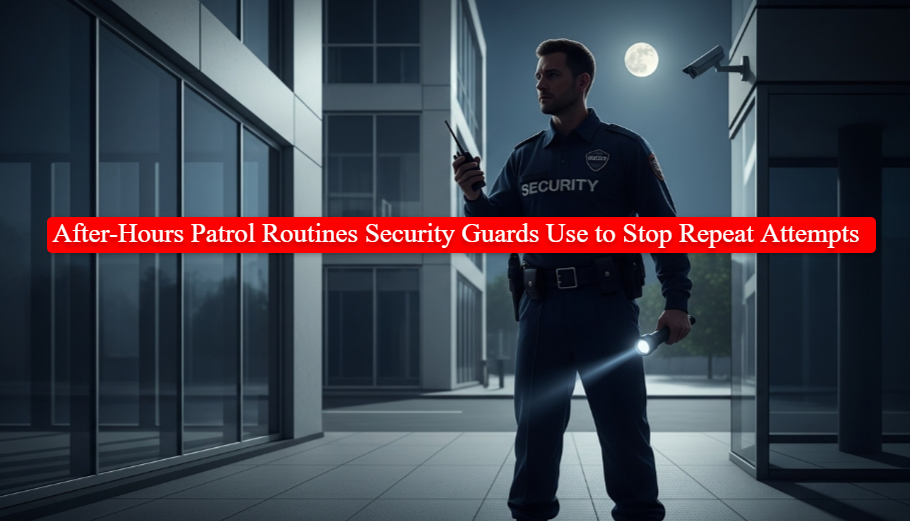
The goal is not to “catch” someone. The goal is to make your side doors too annoying to mess with. Strong security service commercial routines include consistent patrol timing, visible checks, and a documented close-down for after-hours security. This is where security guards for office buildings shine, because consistency is the deterrent.
A clean after-hours routine looks like:
- Start of shift: confirm all side doors are secure, then document exceptions
- Mid-shift: check stairwells, loading areas, and employee entrances
- End of shift: re-check the problem doors, then log corrections
- Weekly: review patterns, adjust routes, and fix the physical issues
Mobile checks can be a fit for some properties. If you want that model, our mobile patrol page explains how routine checks work without full-time staffing.
Managing Cleaners and Vendors Without Losing Side-Door Control
Side doors become the default entrance for late activity. That is normal. The risk is when nobody owns the process.
Simple rules that reduce incidents fast:
- One after-hours entry door, clearly marked and monitored
- A late vendor sign-in process and a call-ahead expectation
- Cleaner access is scheduled and limited to the zones they need
- A “no door propping” rule backed by management, not just guards
If your building has a retail component, the same principle applies to retail building secure entry near service corridors. Keep the flow controlled, keep the door closed, and keep the exceptions documented.
Incident Reporting That Protects Tenants, Owners, and Insurance Claims
If something happens, the report is your proof. Good incident reporting is not long. It is clear.
A solid report includes:
- Exact time and door location, not “back door.”
- What was found (damage, propping, forced entry signs)
- What action was taken (secured door, notified manager, contacted police)
- Photos when safe and appropriate
- Follow-up items (hardware repair, camera angle, lighting fix)
Choosing Office Building Security Guard Services for Southern California Sites
Not every property needs the same solution. Mixed-use sites may need an industrial building security guard. The right mix depends on your hours, tenant profile, and entry points. For many owners, the sweet spot is a clear scope plus reporting, not a vague promise. That is what office building security guard services should deliver.
A simple fit guide:
- On-site guards: best for late-night traffic, multiple side doors, and repeat issues
- Patrol checks: best for quieter buildings needing routine verification
- Monitoring support: best when cameras exist, but response is not consistent
If you manage multiple property types, our industries we serve page can help you map coverage by environment.
Get a Side-Door Security Plan and Quote for Your Building
If your building is in Los Angeles, Orange County, Riverside County, San Bernardino County, or Ventura County, we can build a practical plan for side doors, stairwells, and after-hours routines.
Start with a quick walkthrough and a clear scope. Use get a quote to share your building type, hours, and the doors you are most concerned about. FlagGuard will recommend a coverage plan that fits your schedule and closes the side-door gaps that cause repeat break-ins.