
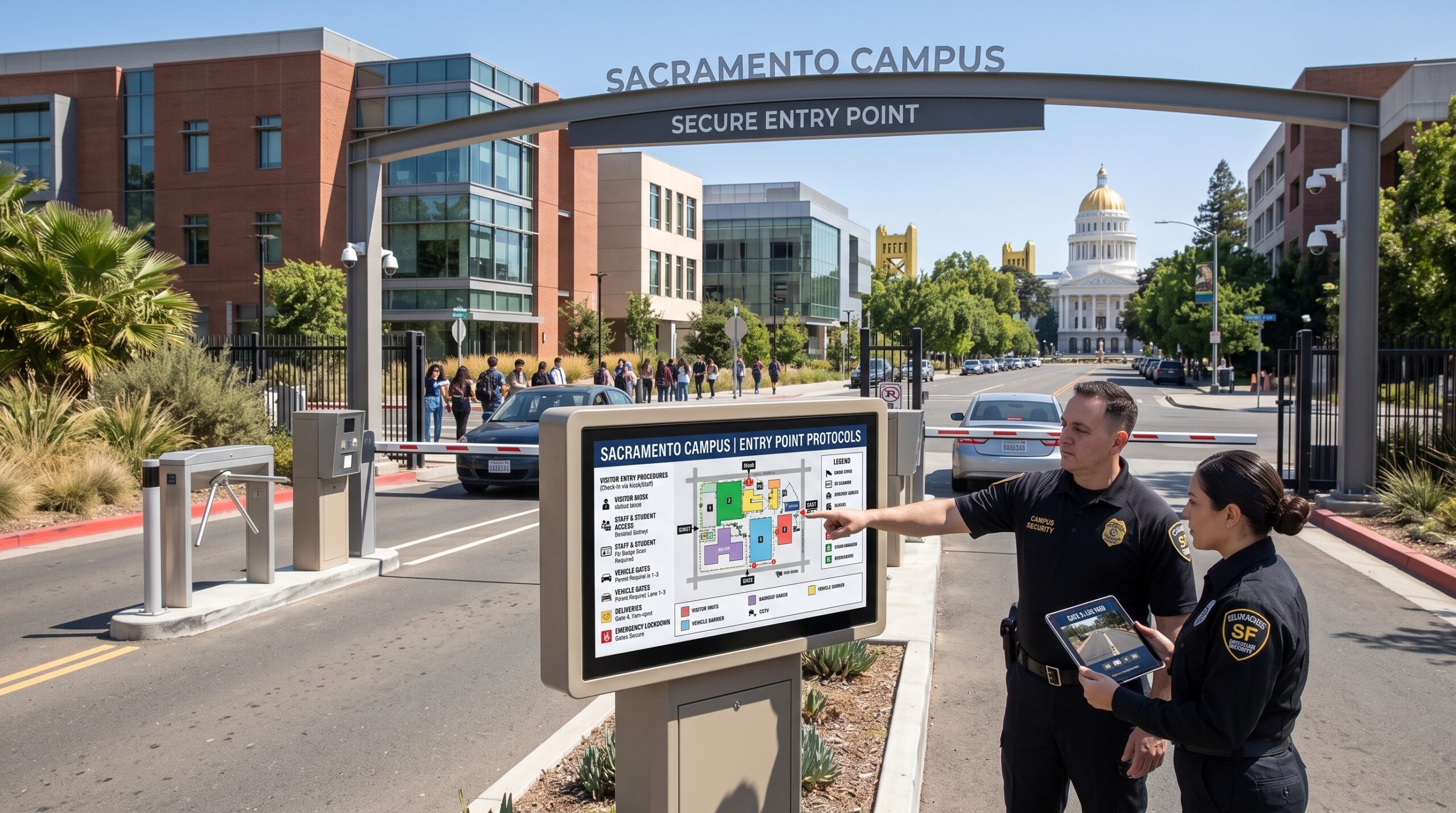

School Campus Security in Sacramento: Keeping Entry Points Safe
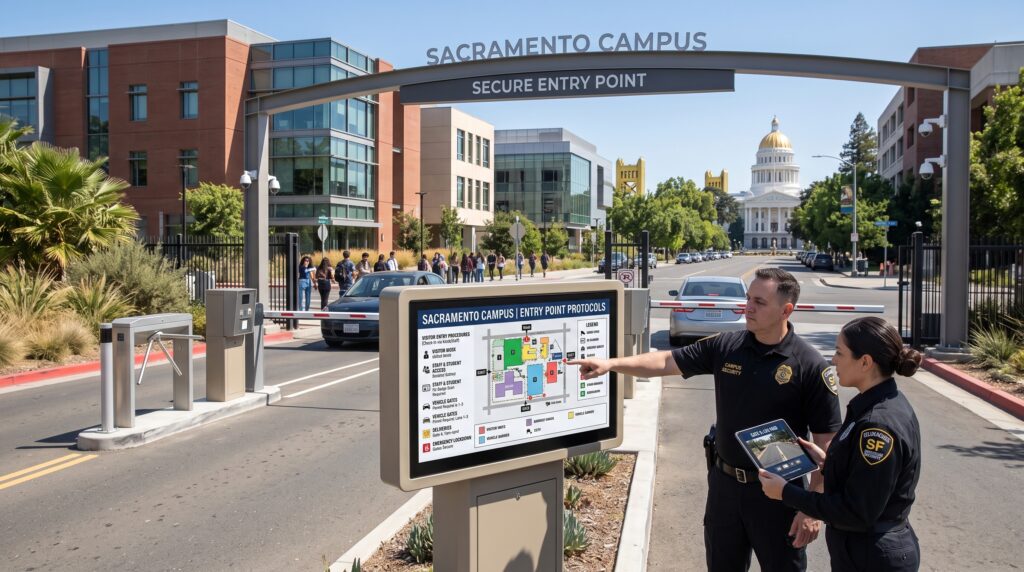
Walk up to most elementary schools in Sacramento at 8:10 in the morning, and you’ll see the same scene: a line of cars along the curb, a crossing guard waving kids through, and a single door where every visitor is supposed to check in. That last part, the “supposed to”, is where a lot of campus security plans quietly fall apart.
Entry points aren’t just doors. They’re the place where a school decides, moment by moment, who gets in and who doesn’t. Get that decision right, and the rest of the campus is easier to protect. Get it wrong, and cameras, alarms, and fencing can’t make up the difference.
This isn’t about scare tactics. It’s about the practical work of keeping a single point of entry actually single, keeping visitor sign-in procedures enforced instead of ignored, and building a plan that holds up during Sacramento’s busiest arrival and dismissal windows, not just on a slide in a safety training deck. Most conversations about security in schools jump straight to cameras and lockdown drills. Fewer start at the door, which is usually where the real work happens.
Why Entry Points Are the First Line of Defense for Sacramento Schools
Every layer of school building security- cameras, fencing, alarms, staff training- exists to support one basic goal: control who walks onto the property and when. The entry point is where that control either holds or doesn’t.
Sacramento districts have made real investments here. Comprehensive school safety plans, built to meet school security requirements under California Education Code, are part of a broader push for public school safety across Sacramento County. Most campuses across Sacramento City Unified, Elk Grove Unified, San Juan Unified, Natomas Unified, and Twin Rivers Unified now design new construction and remodels around a controlled front entrance rather than the old model of multiple unlocked gates. The design intent is solid. The daily execution is where things get harder, especially on older campuses that were never built with a single entry point in mind.
That’s the gap our education security services (https://flagguards.com/services/education-security/) are built to close, not by replacing what a district already has in place, but by adding a trained, visible presence that keeps the entry point working the way it was designed to.
Sacramento’s Growth Means More Traffic at Every Gate
Sacramento isn’t the same city it was a decade ago. Neighborhoods like Natomas, the Pocket, and Elk Grove have absorbed years of new housing growth, and school populations have shifted with them. Add in the daily commuter flow off I-5, Highway 99, and Business 80, and drop-off traffic around campuses near these corridors gets heavier every year.
More cars at the curb means more foot traffic through the front gate, more parents walking in to drop off a forgotten lunch or backpack, and more opportunities for someone to slip through behind a group without stopping at the check-in desk. It’s not usually malicious. It’s just how crowded, well-meaning chaos works. But a school’s security posture has to account for it anyway, because the busiest fifteen minutes of the day are exactly when an unsupervised entry point is most likely to fail.
The Single Point of Entry Standard — and Where It Breaks Down
“Single point of entry” sounds simple: one door, one check-in process, everything else locked. In practice, most Sacramento campuses run into the same three problems.
First, side doors get propped for deliveries, custodial access, or a teacher stepping out for fresh air, and they don’t always get closed again right away. Second, the front office staff running check-in are also answering phones, handling attendance calls, and managing a dozen other things; sign-in enforcement becomes one more task competing for attention. Third, older campuses built before the single-entry standard often have gates or paths that make a truly single point of entry a stretch, even with good intentions.
None of these are failures of effort. They’re failures of bandwidth. A campus with a dedicated, trained presence at the entry point, someone whose only job during arrival is watching that door, solves all three at once, without asking already-stretched office staff to do more.
Visitor Sign-In Isn’t Enough Without Enforcement
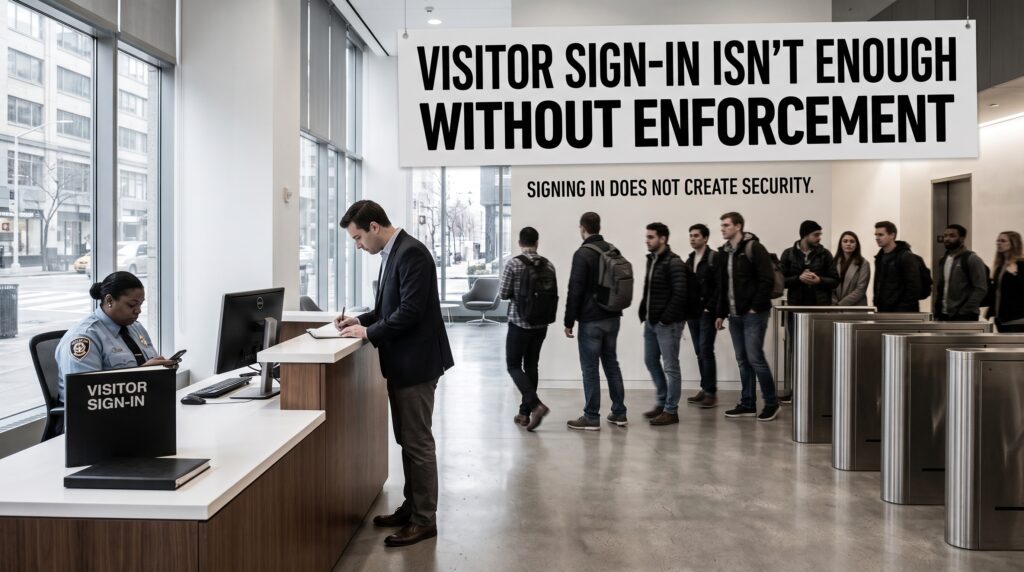
Nearly every school in Sacramento has a visitor sign-in policy. Almost none of them have a system for catching the person who doesn’t follow it. That’s the actual gap.
A sign-in sheet or digital badge system is a good foundation, but it only works if someone is positioned to notice when it’s skipped: the parent who walks in behind a group of students, the delivery driver who heads straight for a side door, the visitor who signs in but never puts on a badge. Real enforcement means:
A trained presence that greets every visitor before they’re past the check-in point, not after. Clear escalation steps for anyone who bypasses the process, handled calmly and without confrontation. Consistent daily habits, so the process feels routine rather than like an occasional inconvenience. Coordination with front office staff so the security presence and the administrative process work as one system, not two. Put together, these habits are what turn written safety and security procedures into something staff and students actually experience every morning.
We cover this same challenge from the office-desk side in our post on front desk security and visitor policies (https://flagguards.com/front-desk-security/), which is worth a look if your check-in process lives mostly at a reception counter rather than a gate.
Arrival and Dismissal: Sacramento’s Busiest Security Window
If there’s one stretch of the day where entry point discipline matters most, it’s the twenty minutes before the first bell and the twenty minutes after the last one. This is when traffic peaks, when staff attention is split between safety and logistics, and when a crowded sidewalk makes it easy for someone to blend in.
Sacramento’s school zones handle this differently depending on location. Campuses near arterial roads and freeway on-ramps often see backed-up drop-off lines that spill into street parking, pulling staff attention toward traffic management and away from the gate itself. Campuses in quieter residential pockets face the opposite issues; lower visible traffic can mean less vigilance, since nothing looks obviously wrong.
Either way, a dedicated presence at the entry point during these windows means someone is watching the door specifically, instead of the door being a side responsibility for whoever happens to be nearby. That’s the difference between a policy that exists on paper and one that holds up in practice, and it’s usually the moment when safety and security at school gets tested, not during a quiet third period.
High school security tends to look different from this same window at an elementary campus. Older students come and go for open periods, sports practice, or off-campus lunch, and a larger, more spread-out site often means more than one gate to watch. The entry point principle stays the same, but the staffing plan has to flex around a bigger, busier footprint.
Fog, Heat, and Sacramento’s Seasonal Visibility Challenges
Sacramento’s Central Valley climate creates its own entry point challenges. Winter tule fog can cut visibility across parking lots and drop-off lanes to a few dozen feet during the exact hours when arrival traffic peaks. Summer heat pushes daily temperatures well past 90 degrees for months at a time, which changes how long a guard or staff member can comfortably stand at an exposed outdoor post and how quickly fatigue sets in during a long shift.
Neither of these is a reason to loosen entry point coverage; if anything, low-visibility mornings are when a controlled, monitored gate matters most. But it does mean staffing plans, shade and hydration provisions, and visibility aids (reflective vests, clear sightlines, adequate lighting even on foggy mornings) need to be built into the plan rather than treated as an afterthought.
Building an Entry Point Security Plan That Actually Works

A workable plan for Sacramento campuses usually comes down to a few concrete pieces:
A single, clearly marked entry point with every other exterior door locked or alarmed during school hours. A dedicated person, not a multitasking staff member, responsible for watching that entry point during arrival and dismissal. A sign-in process that’s actually enforced, with a defined, calm response for anyone who doesn’t follow it. Clear coordination between whoever staffs the gate and the front office, so information moves both directions. A seasonal adjustment for fog, heat, and daylight changes across the school year.
None of this replaces existing school security systems like cameras or alarms; it works alongside them. Locks and access control reduce opportunity. Cameras and monitoring add visibility. A trained person at the entry point is what turns a policy into daily practice. If your campus already has after-hours coverage in place, it’s worth reading our breakdown of after-hours school security gaps (https://flagguards.com/after-hours-school-security/) as a companion piece. Daytime entry control and after-dark protection are different problems, but they’re both part of the same overall plan.
Getting the Right Coverage for Your Sacramento Campus
Every campus is laid out a little differently, and a plan that works for a K-12 school in Elk Grove won’t necessarily fit a community college site near downtown. That’s why we start with a walkthrough of your specific entry points, traffic patterns, and daily schedule before recommending coverage. Our Sacramento security services (https://flagguards.com/locations/sacramento/) are built around exactly this kind of site-specific planning, whether you need a dedicated presence at morning drop-off, full-day coverage, or a hybrid plan built around your riskiest hours.
If your school’s entry points need a second look, reach out to our team (https://flagguards.com/contact/) for a straightforward assessment and a coverage plan built around how your campus actually runs — not a generic template.
Frequently Asked Questions
How much does school security cost in Sacramento?
Cost depends on coverage hours, the number of entry points, and whether you need a single dedicated guard or a broader campus patrol plan. Most Sacramento schools start with a walkthrough and a site-specific quote rather than a flat rate, since a small elementary campus and a large high school have very different staffing needs. Contact FlagGuard for a coverage plan and pricing based on your actual campus layout.
Do Sacramento schools require a security guard at the front entrance?
California doesn’t mandate a guard at every school entrance, but districts are required to maintain comprehensive school safety plans under state Education Code, and many campuses choose dedicated entry point staffing to meet that standard in practice. Whether a guard is the right fit depends on your campus size, traffic patterns, and existing visitor management process.
What is single-point-of-entry security for a school?
Single point of entry means every visitor, after the first bell, has to pass through one controlled and monitored entrance while every other exterior door stays locked. It’s a widely used campus design standard because it concentrates visitor screening and sign-in enforcement at one location instead of spreading it across multiple unmonitored doors.
How do I stop people from bypassing visitor sign-in at school?
The most effective fix is a dedicated person stationed at the entry point during arrival, dismissal, and other high-traffic periods, since a sign-in sheet alone can’t catch someone who walks past it. Pairing that presence with clear, calmly enforced escalation steps closes most of the gap between a written policy and daily practice.
Who provides campus security guards in Sacramento, CA?
FlagGuard provides licensed campus and school security guards across Sacramento, with coverage built around your entry points, bell schedule, and visitor procedures. Call 818-818-8111 or get in touch through our contact page (https://flagguards.com/contact/) to set up a site walkthrough and coverage plan.