

Office Building Security in San Francisco: After-Hours Protection
Walk through the Financial District after 7 p.m., and the energy changes fast. The lunch crowds are gone, half the office towers go dark floor by floor, and the fog starts rolling in off the Bay, cutting visibility on side streets long before most tenants have locked up. That’s exactly the window when office building security in San Francisco matters most not during the nine-to-five rush, but in the hours nobody’s watching.
San Francisco’s downtown core is dense in a way few U.S. cities match. Tech offices, law firms, and financial services tenants stack on top of each other in the same towers, often with different hours, different access needs, and different vendors coming and going. A single building might have a startup running late-night sprints on the 12th floor, a cleaning crew starting at 9 p.m., and a loading dock that gets deliveries well past dark. That mix is exactly why generic security for buildings doesn’t hold up; SF office properties need coverage built around the city’s actual traffic patterns, not a one-size template.
Why San Francisco Office Buildings Face Distinct After-Hours Risk
Three things set San Francisco apart from other California business hubs when it comes to commercial security services:
- Geography and weather. Fog rolls in early in neighborhoods like SoMa and the Embarcadero, cutting visibility on exterior approaches well before most staff leave. Combined with steep, narrow streets near the Financial District, sightlines around building entrances shrink fast after dusk.
- Transit-driven foot traffic. BART and Muni stations near Market Street and the Embarcadero push large volumes of people past office lobbies at irregular hours, which makes it harder to spot who’s actually headed into your building versus who’s just passing through.
- Mixed-tenant density. A single high-rise can house a tech campus annex, a law firm, and a co-working space under one roof, each with different badge schedules. That complexity is where access-control gaps tend to open up.
None of this means San Francisco is uniquely dangerous. It means the coverage plan has to account for real conditions on the ground, not assumptions carried over from a suburban office park.
What Office Building Security Actually Covers
When people search for security building services, they’re usually picturing a guard standing in a lobby. In practice, a well-built office building security plan covers more ground than that:
- Lobby and entrance presence during business hours and staggered evening departures
- Access control support at badge readers, turnstiles, and secondary entrances
- Perimeter and exterior checks covering loading docks, parking structures, and stairwell exits
- After-hours patrol rounds verifying doors are secured, not just closed
- Incident response and documentation for property managers, tenants, and insurers
Our commercial security services page breaks down the full scope of what’s included for offices, retail, and mixed-use properties across Southern California, and the same framework applies to San Francisco sites, adjusted for local building types and traffic.
On-Site Guards vs. Security Patrol: Which Fits Your Building?
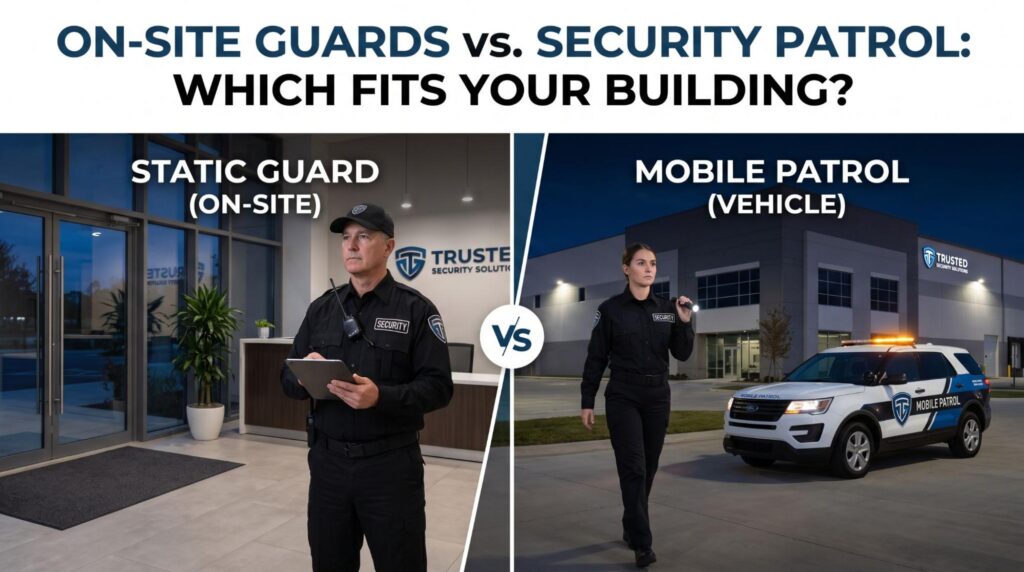
This is one of the most common questions from property managers evaluating security guard companies in San Francisco, and the honest answer is: it depends on your building’s traffic pattern.
On-site guards make sense when:
- Your building has multiple tenants with staggered hours
- There’s regular after-hours vendor or contractor access
- The lobby sees enough foot traffic that a static presence adds real value
San Francisco security patrol (scheduled mobile checks rather than a stationed guard) fits better when:
- The building is quieter after a fixed closing time
- You need verification of doors, lighting, and common areas without full-time staffing
- Budget favors periodic coverage over continuous presence
Some properties end up using both: an on-site guard during peak hours, then patrol checks overnight. That hybrid approach tends to work well for mid-rise office buildings in SoMa and Mission Bay, where daytime density is high, but the building empties out fairly completely by 8 or 9 p.m.
Armed vs. Unarmed: What San Francisco Office Buildings Typically Need
Most office building security assignments in San Francisco use unarmed, licensed guards, trained in access control, de-escalation, and incident reporting rather than armed response. Armed security in San Francisco is more common for higher-risk assignments: cash-handling operations, certain financial institutions, or properties with a documented history of serious incidents. If you’re unsure which category your building falls into, that’s a conversation worth having before you sign a contract, not after an incident.
Choosing Between Security Companies in San Francisco, CA
Not every security company operating in the city is set up the same way, and the differences matter:
- Licensing. Confirm the company holds a valid California BSIS PPO license and that individual guards are registered, not just the company.
- Local familiarity. A company that regularly works Financial District high-rises will plan differently than one used to suburban business parks.
- Reporting. Ask how incidents and patrol checks get documented; vague verbal updates aren’t useful if you ever need records for insurance or legal purposes.
- Contract flexibility. The office needs a shift. Month-to-month or trial-based coverage is worth asking about instead of locking into a long-term contract before you know what fits.
If you’ve already reviewed our San Francisco security guard services page, you’ve seen the neighborhood-by-neighborhood breakdown; this is the operational side of how that coverage actually gets delivered once guards are on-site.
Building an After-Hours Security Routine That Actually Holds
A strong after-hours plan isn’t complicated, but it does need to be consistent. At minimum, it should include:
- A documented lock-up check at the start of the overnight shift
- Mid-shift rounds covering stairwells, loading areas, and secondary entrances
- A clear escalation path if something looks wrong, who gets called, and in what order
- Weekly review of patterns, so recurring issues (a door that won’t latch, a badge reader acting up) get fixed instead of re-discovered
If your building has had recurring access-point issues, our related piece on office side-door security guards covers the specific tactics guards use to close that particular gap.
Get a San Francisco Office Building Security Plan
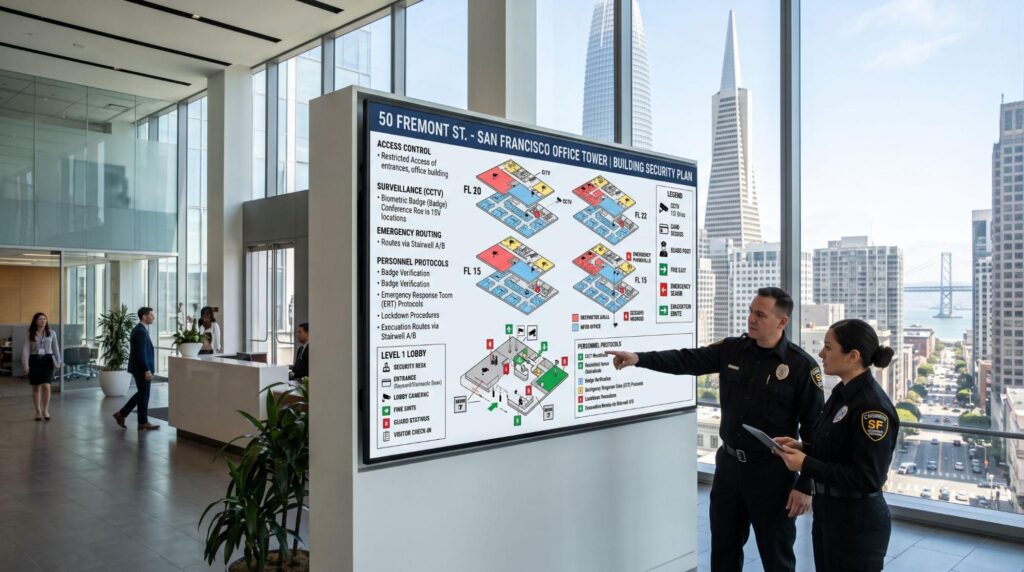
If you manage an office property in the Financial District, SoMa, Mission Bay, or elsewhere in San Francisco, the right coverage depends on your building’s layout, hours, and tenant mix, not a generic package. Contact FlagGuard to walk through your building’s specific access points and get a coverage plan built around how your property actually runs after hours.
5. FAQs
How much does office building security cost in San Francisco?
Cost depends on coverage type (on-site guard vs. patrol), hours needed, and whether armed coverage is required. Buildings with multiple tenants and later closing times typically need more coverage hours than single-tenant offices with an early close. Request a quote with your building’s specifics for an accurate estimate.
Do office buildings need armed security guards?
Most San Francisco office buildings use unarmed, licensed guards trained in access control and incident response. Armed coverage is typically reserved for higher-risk operations, such as cash handling or properties with a documented history of serious incidents.
What’s the difference between a security patrol and an on-site guard?
An on-site guard is stationed at your building continuously, while a security patrol involves scheduled checks at set intervals. Patrol coverage works well for quieter buildings after a fixed closing time; on-site guards fit buildings with ongoing after-hours traffic.
Are San Francisco security companies required to be licensed?
Yes. California law requires security guards and companies to hold a license issued by the Bureau of Security and Investigative Services (BSIS). Always confirm both the company’s license and individual guards’ registration before signing a contract.
How do I get started with office building security in San Francisco?
Contact FlagGuard to share your building’s location, hours, and access points. We’ll walk through your property’s layout and put together a coverage plan- on-site, patrol, or a hybrid of both- suited to how your building actually operates after hours.